Short answer: most delays at Dubai customs are caused by documents, not the goods. The ten most common mistakes are mismatched documents, vague descriptions, wrong HS codes, wrong values, wrong origin, missing permits, an expired importer registration, late documents, missing labels or markings, and ignoring free time. Each one is avoidable if your documents are checked before the cargo arrives.
Why small mistakes cause big delays
When an import declaration does not match the documents or the goods, Dubai Customs can hold the shipment for correction, ask for more documents or select the container for physical inspection. Meanwhile, the cargo sits at the port. Storage, demurrage and detention charges start once free time ends and grow every day. A small typo on an invoice can end up costing more than the clearance itself.
The 10 most common mistakes
1. Documents that do not match
The commercial invoice, packing list and bill of lading must agree on the consignee, the description, the number of packages and the weights. If the invoice says 120 cartons and the bill of lading says 118, customs will ask why.
Fix: check all three documents side by side before the supplier sends them. Ask your forwarder to review the drafts.
2. Vague goods descriptions
Descriptions such as “spare parts”, “general goods” or “accessories” do not tell customs what is in the container. Vague descriptions lead to questions, reclassification and inspections.
Fix: describe each item clearly, for example “steel brake discs for passenger cars” rather than “auto parts”.
3. Wrong HS codes
The HS code decides the duty rate and whether a permit is needed. Using a code that is too general, or one copied from a previous shipment of different goods, is a common error.
Fix: confirm the HS code for each product, especially new ones. A wrong code can mean underpaid duty and a fine, or overpaid duty that is hard to recover.
4. Wrong or unsupported values
Customs duty is based on the CIF value. If the invoice value looks too low for the goods, customs can reassess it. Missing freight or insurance costs also change the value.
Fix: declare the real transaction value, include freight and insurance correctly, and keep payment records in case customs asks.
5. Wrong country of origin
Origin is where the goods were made, not where they were shipped from. Declaring the wrong origin affects duty and trade-agreement benefits and can lead to penalties.
Fix: get a certificate of origin from the supplier that shows the true country of manufacture. See re-export from Dubai for how origin works with re-exports.
6. Missing permits or registrations
Many goods need approval from a UAE authority before customs releases them:
- Food needs importer and product registration with Dubai Municipality. See FIRS.
- Cosmetics need registration through Montaji. See Montaji.
- Regulated electrical goods need an ECAS certificate. See ECAS.
- Wireless devices need TDRA type approval. See TDRA.
- Medical devices need registration and import permits. See medical devices.
- Plants, seeds and animal products need MOCCAE permits. See MOCCAE.
Fix: check whether your product needs approval before you buy it, not after it lands.
7. Expired importer registration
If your trade licence or Dubai Customs client code has expired, declarations in your company’s name can be rejected, even when everything else is correct.
Fix: renew your licence and update your customs registration before they expire. See Dubai Customs client code.
8. Sending documents late
Documents that arrive after the vessel mean the declaration cannot be prepared in advance. Original bills of lading that are still with a bank or the supplier also hold up release.
Fix: ask the supplier to send scanned documents as soon as the vessel sails, and arrange a telex release or seaway bill where the payment terms allow. See house vs master bill of lading.
9. Missing labels and markings
Some goods need Arabic labelling, country-of-origin marking or specific product labels. Cartons without marks are also harder to match to the packing list during inspection.
Fix: confirm labelling rules for your product before production, and mark each carton with the shipment reference and carton number.
10. Ignoring free time
Every shipment has a limited number of free days before port storage, demurrage and detention start. Importers who wait for funds, a warehouse slot or a missing document often go past free time without noticing.
Fix: know your free days before the vessel arrives and plan clearance and delivery inside them. See demurrage and detention in the UAE.
A pre-arrival checklist
| Check | Done? |
|---|---|
| Invoice, packing list and bill of lading match | ☐ |
| Clear description for every item | ☐ |
| Correct HS code for every item | ☐ |
| Value includes correct freight and insurance | ☐ |
| Certificate of origin shows true origin | ☐ |
| Permits and registrations in place | ☐ |
| Trade licence and customs code valid | ☐ |
| Documents sent to clearing agent before arrival | ☐ |
| Labels and carton marks correct | ☐ |
| Free days known and delivery booked | ☐ |
What happens during an inspection
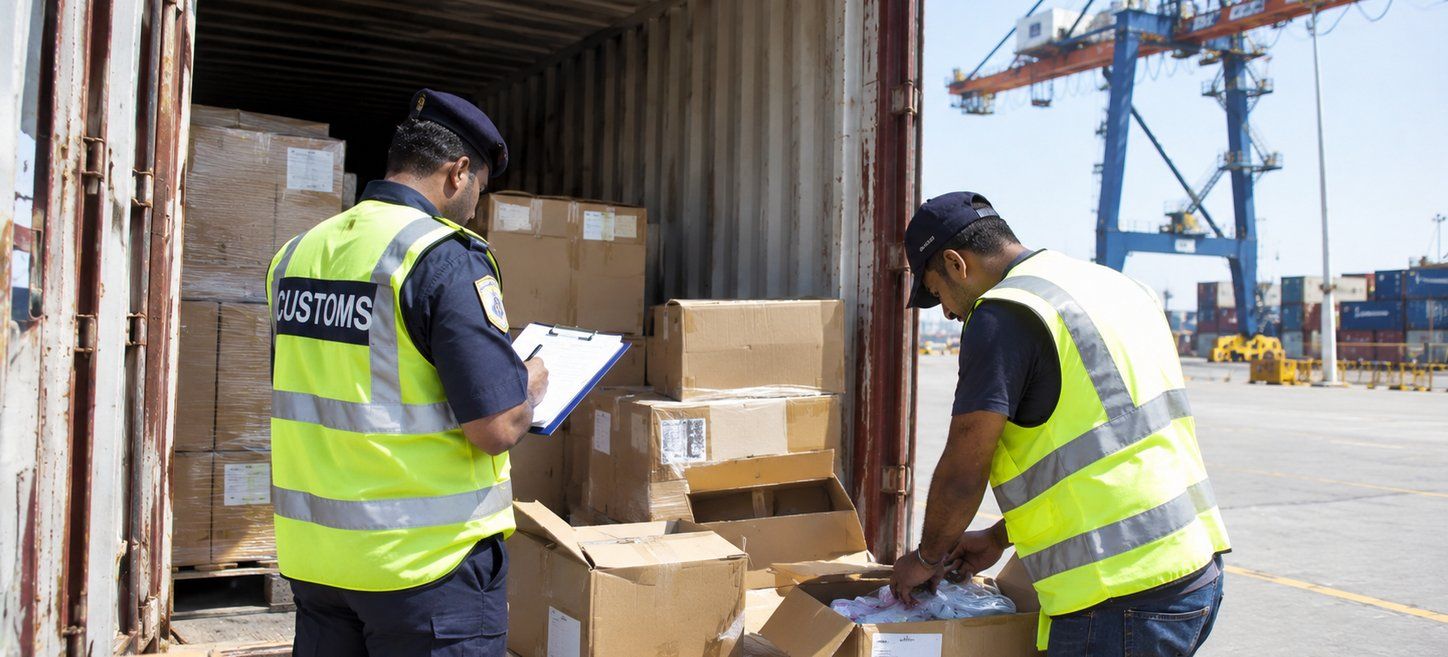
If customs selects a container for inspection, it is moved to an inspection area, opened and checked against the declaration. You pay for the container moves and any labour. Inspections take extra time, so a container selected near the end of its free time can quickly run into storage charges.
Clear, matching documents reduce the chance of inspection and make it faster if one happens.
What it costs to get it wrong (illustrative)
This example is illustrative only. A 40′ container of household goods arrives with an invoice showing a total value but no per-item breakdown, and two products need permits that were never applied for.
- The declaration is held while a corrected invoice is requested from the supplier.
- The permits take several working days to obtain.
- The container goes past its free days at the port.
- Port storage and shipping line demurrage are charged for each extra day.
The goods are eventually cleared, but the delay costs more than the clearing agent’s fee, and the importer’s customer receives the order late.
Mistakes specific to LCL shipments
LCL cargo shares a container with other shippers’ goods, so a problem with one shipment can affect release from the container freight station.
- Unclear carton marks make it hard to identify your goods when the container is unpacked.
- Packing lists without carton numbers slow down counting and inspection.
- Small value discrepancies still trigger queries, even on a small shipment.
Mark every carton with the consignee and carton number, and make sure the packing list shows what is in each one. See LCL shipping from Dubai.
How to fix a held shipment
If your shipment is already held, act quickly:
- Ask your clearing agent exactly why the shipment is held and what is needed.
- Request corrected documents from the supplier the same day.
- Apply for any missing permit immediately.
- Check how many free days remain and ask whether an extension is possible.
- Keep records of every correction, so the same mistake is not repeated.
Key takeaways
- Most customs holds in Dubai are caused by documents, not by the goods themselves.
- The invoice, packing list and bill of lading must match on packages, weights and descriptions.
- Correct HS codes decide the duty rate and whether a permit is needed.
- Regulated goods need approvals such as FIRS, Montaji, ECAS, TDRA or MOCCAE before release.
- An expired trade licence or customs code can stop an otherwise correct clearance.
- Plan clearance inside free time, because storage and demurrage grow every day.
How a good clearing agent helps
A good customs broker checks your documents before arrival, confirms HS codes and permits, prepares the declaration in advance and tells you exactly what is missing. That is often the difference between a container released on arrival and one held for a week.
Our team handles customs clearance in Dubai together with port release and delivery. Send your documents with a quote request and we will check them before your cargo arrives. For the full document list, see documents required for import customs clearance.