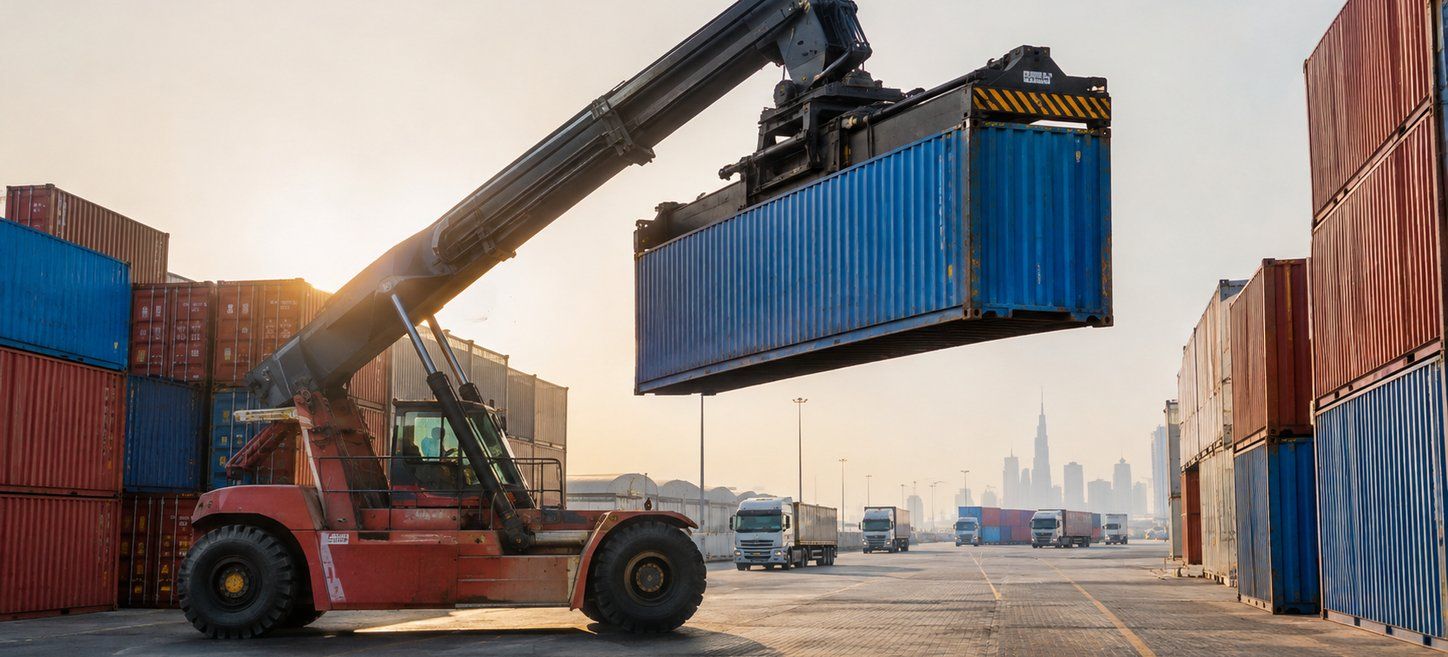
Short answer: a re-export is a shipment of foreign goods that enter the UAE and leave again without being substantially changed. In Dubai, you can re-export from a free zone (no duty paid while goods are stored), under a transit declaration (goods pass through without entering the local market), or from the mainland after duty has been paid and later refunded. The right route depends on how long the goods stay, where they are stored and whether any of them will be sold in the UAE.
Why Dubai is a re-export hub
Dubai sits between producers in Asia and buyers in the Gulf, Africa and South Asia. Jebel Ali is the largest container port in the Middle East, and the city combines it with major airports, large free zones and trucking routes into the rest of the GCC.
That combination lets a trader buy in bulk from China or India, hold stock close to many markets, split it into smaller orders and ship each one on short notice. General trading companies are built around this model. A single order might combine electronics, hardware and spare parts from a dozen suppliers before it ships to a buyer in Kenya, Pakistan or Saudi Arabia.
The three ways to re-export from Dubai
There are three common routes, and each treats customs duty differently.
| Route | Where the goods sit | UAE duty | Typical use |
|---|---|---|---|
| Free zone re-export | A free zone warehouse (for example in Jebel Ali or the airport free zones) | Not paid while goods stay in the free zone | Stock held for regional distribution |
| Transit | In the port, a bonded area or on a truck passing through | Not paid; goods are under customs control | Goods only passing through the UAE |
| Mainland re-export | A mainland warehouse after import clearance | Paid on import; refundable on re-export if conditions are met | Traders who sell locally and abroad |
Free zone re-exports
A free zone is a designated area treated as outside the UAE customs territory for duty purposes. Goods can be imported, stored, repacked and re-exported without paying the 5% UAE customs duty, provided they do not move into the mainland. Duty and 5% VAT become due only if the goods are sold into the UAE market.
Free zones suit companies whose customers are mostly outside the UAE. The trade-off is that the company needs a free zone licence and the goods need a licensed free zone warehouse.
Transit through the UAE
Transit means goods enter and leave the UAE under customs control without being cleared for local use. A common example is cargo landed at Jebel Ali and trucked straight to Saudi Arabia or Oman. A transit declaration is filed, the goods are tracked to the exit point, and no UAE duty is charged.
Transit works when the onward buyer and route are already known. It is not designed for long storage.
Mainland re-exports and duty refunds
Goods cleared into the mainland pay duty on arrival, usually 5% of the CIF value. If they are later re-exported in the same condition, the importer can apply to Dubai Customs for a duty refund. Refunds come with a time limit and require proof that the goods leaving match the goods that came in. Check the current conditions with Dubai Customs before relying on a refund in your pricing.
Documents for a re-export shipment
Most re-export problems come from documents that do not link the outgoing goods to the original import. A typical set includes:
- Commercial invoice for the onward sale, with a clear description, quantity and value.
- Packing list that matches the invoice line by line.
- Reference to the original entry, such as the import, free zone entry or transit declaration number.
- Exit or re-export declaration filed with Dubai Customs.
- Certificate of origin showing the true country of manufacture, not the UAE.
- Bill of lading or air waybill for the onward leg.
- Destination certificates the buyer’s customs requires, such as conformity certificates or permits.
See our checklist of documents for import customs clearance in Dubai for the import side of the same paperwork.
How to declare the origin correctly
Origin means the country where the goods were made, not the country they were shipped from. Goods made in China and re-exported from Dubai are still Chinese-origin goods. Declaring them as UAE origin is a serious error: it can trigger penalties and lose the buyer any trade-agreement duty benefit.
Goods only gain UAE origin if they are substantially processed in the UAE, in line with the applicable rules of origin. Repacking, relabelling or splitting a shipment does not change origin.
A worked example (illustrative)
This example is illustrative only. A Dubai trading company buys 1,200 cartons of kitchen appliances from a factory in China and ships them in two 40′ containers to its warehouse in a Jebel Ali free zone. No duty is paid on arrival because the goods stay in the free zone.
Over the next two months, the company sells the stock in smaller lots:
- 300 cartons to a buyer in Mombasa, shipped LCL from Jebel Ali with a Chinese certificate of origin.
- 500 cartons to a distributor in Riyadh, trucked across the Al Ghuwaifat border.
- 400 cartons sold to a UAE retailer, which triggers 5% duty and 5% VAT when the goods leave the free zone for the mainland.
Each movement has its own exit or import declaration that refers back to the original free zone entry. The company only pays UAE duty on the 400 cartons actually sold in the UAE.
Re-exporting by sea, road and air
By sea: most re-exports to Africa, South Asia and the wider Gulf leave Jebel Ali as FCL or LCL. LCL suits small onward orders. Read FCL vs LCL to compare the two.
By road: trucks carry re-exports to Saudi Arabia, Oman, Qatar, Bahrain and Kuwait. The consignee’s agent clears the goods at the destination border, and product certificates such as SABER for Saudi Arabia must be ready before the truck leaves. See Dubai to Saudi Arabia.
By air: high-value or urgent re-exports move through Dubai’s airports, often from an airport free zone.
Re-export markets: what each region usually asks for
Destination rules matter as much as UAE paperwork, because the buyer’s customs decides whether the goods are released. Requirements change, so confirm them with the buyer for every new product.
| Region | Common requirements to check |
|---|---|
| Saudi Arabia | SABER conformity certificates for regulated products; Arabic labelling for consumer goods |
| Oman, Qatar, Bahrain, Kuwait | GCC conformity marks for some products; certificate of origin; buyer’s import registration |
| East Africa (e.g. Kenya, Tanzania) | Pre-export verification of conformity for many products; certificate of origin; accurate HS codes |
| South Asia (e.g. Pakistan, Sri Lanka) | Buyer’s import registration and tax numbers; certificates for regulated goods; letter of credit terms where used |
| Iraq and Yemen | Destination conformity and inspection rules; sanctions screening before booking |
Many re-export buyers pay by letter of credit. In that case, the bill of lading, invoice and certificate of origin must match the credit terms word for word, so share the LC with your forwarder before the documents are drafted.
How long can goods stay in Dubai before re-export?
Goods in a free zone can generally be stored for long periods, which is why free zones are popular for distribution stock. Goods under transit are expected to leave within the time allowed on the transit declaration. Goods on the mainland can stay as long as you like, but a duty refund is only possible within the refund time limit. If you are not sure how long stock will stay, a free zone keeps your options open.
Five mistakes that cost re-exporters money
- Declaring the wrong origin. Always declare where the goods were made.
- Losing the link to the import entry. Keep the entry reference for every lot you store.
- Moving free zone goods into the mainland without declaring it. This makes duty and VAT payable, with possible penalties.
- Assuming the buyer’s customs will accept UAE documents. Many countries need their own certificates or pre-shipment inspections.
- Pricing around a duty refund that never arrives. Refunds have conditions and time limits, so confirm them first.
Is re-exporting from Dubai right for you?
Re-exporting from Dubai makes sense when you sell to several regional markets, need stock close to buyers, or want to split large factory orders into smaller shipments. It makes less sense when goods only ever go to one destination in full containers. In that case, shipping direct from the factory is usually cheaper.
If you are planning re-exports, our team can handle the sea or road leg, the exit and transit declarations, and the onward bill of lading. Read how we work with general trading companies, or request a quote with your origin, destination and cargo details.