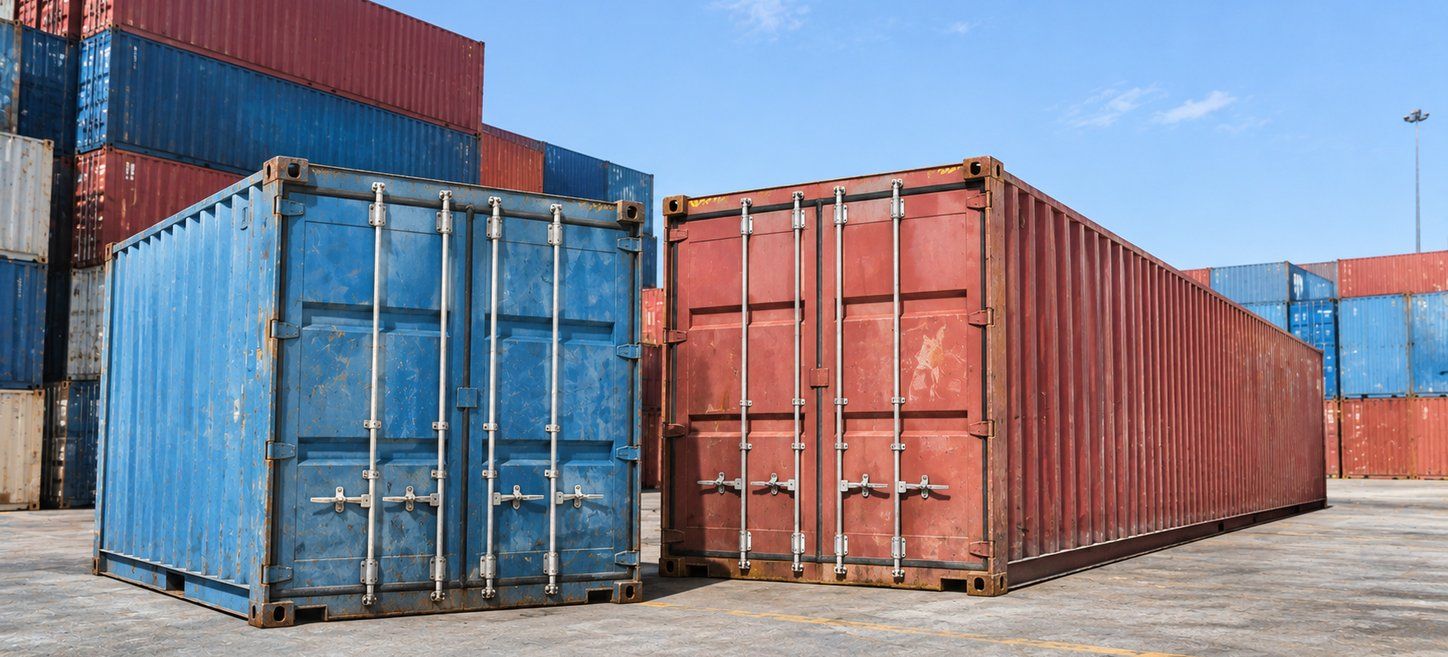
Short answer: the three most common shipping containers are the 20ft standard (about 33 m³), the 40ft standard (about 67 m³) and the 40ft high cube (about 76 m³). All are 2.44 m wide. Standard boxes are 2.59 m high outside and high cubes 2.90 m. A 20ft usually suits heavy cargo and a 40ft or high cube suits light, bulky cargo. Exact figures vary by manufacturer, so always check the plate on the container doors.
Container dimensions at a glance
The figures below are typical for steel dry containers. Individual containers vary by a few centimetres and kilograms.
| 20ft standard | 40ft standard | 40ft high cube | |
|---|---|---|---|
| External length | 6.06 m | 12.19 m | 12.19 m |
| External width | 2.44 m | 2.44 m | 2.44 m |
| External height | 2.59 m | 2.59 m | 2.90 m |
| Internal length | 5.90 m | 12.03 m | 12.03 m |
| Internal width | 2.35 m | 2.35 m | 2.35 m |
| Internal height | 2.39 m | 2.39 m | 2.69 m |
| Door opening (W × H) | 2.34 × 2.28 m | 2.34 × 2.28 m | 2.34 × 2.58 m |
| Internal volume | about 33 m³ | about 67 m³ | about 76 m³ |
| Tare (empty) weight | about 2,200–2,300 kg | about 3,700–3,800 kg | about 3,900–4,000 kg |
| Max gross weight (typical) | 30,480 kg | 30,480 kg | 30,480 kg |
Some newer containers are rated for a higher maximum gross weight. The actual ratings are shown on the CSC safety approval plate and on the container doors.
Why “20ft” and “40ft” are not exact
The names refer to the nominal external length. A 20ft container is slightly less than 20 feet long, so that two 20ft boxes fit in the space of one 40ft box with a small gap. The industry measures capacity in TEU (twenty-foot equivalent units): a 20ft container is 1 TEU, and a 40ft is 2 TEU, often called 1 FEU.
How much cargo actually fits
Internal volume is not the same as usable volume. Pallets, packaging gaps, the door opening and lashing take up space. As a working guide:
| Container | Internal volume | Practical loadable volume |
|---|---|---|
| 20ft standard | about 33 m³ | about 25–28 m³ |
| 40ft standard | about 67 m³ | about 55–58 m³ |
| 40ft high cube | about 76 m³ | about 65–68 m³ |
Pallets
Standard pallets do not fit containers perfectly, because containers were designed before pallet sizes were standardised. Typical single-layer counts:
- 20ft: about 10 pallets of 1.2 × 1.0 m, or 11 euro pallets (1.2 × 0.8 m).
- 40ft: about 20–21 pallets of 1.2 × 1.0 m, or 23–24 euro pallets.
Double stacking depends on pallet height, weight and how strong the packaging is.
Weight limits: the part shippers often get wrong
A container’s payload is its maximum gross weight minus its tare weight. A 20ft box rated 30,480 kg with a tare of 2,300 kg can carry roughly 28,000 kg. In practice, the limit is often lower:
- Road weight limits for trucks carrying the container to and from the port.
- Shipping line limits on certain routes or vessels.
- Even weight distribution: heavy cargo concentrated in one spot can damage the floor or make the container unsafe to lift.
Before a loaded container can board a vessel, the shipper must declare its verified gross mass (VGM) under the SOLAS convention. Overweight or wrongly declared containers can be refused loading.
20ft or 40ft: which should you choose?
| Your cargo | Usually best | Why |
|---|---|---|
| Steel, tiles, stone, machinery | 20ft | Reaches the weight limit before the space runs out |
| Furniture, garments, foam, plastics | 40ft or 40ft high cube | Light and bulky; you pay for space |
| Tall items such as machinery or racking | 40ft high cube | The extra 30 cm of height |
| Mixed cargo, medium density | 40ft | Lower cost per cubic metre |
| Less than about 13–15 m³ | LCL | Cheaper than a full container |
A 40ft container rarely costs twice as much as a 20ft, so light cargo is often cheaper per cubic metre in a 40ft. See container shipping cost from Dubai and FCL vs LCL.
Special container types
Not all cargo fits a standard dry box. Common alternatives:
| Type | What it is | Typical cargo |
|---|---|---|
| Reefer | Insulated with a refrigeration unit | Food, pharmaceuticals, flowers |
| Open top | Removable roof covered by a tarpaulin | Tall machinery loaded by crane |
| Flat rack | Floor and end walls, no sides or roof | Vehicles, heavy equipment, out-of-gauge cargo |
| Platform | A flat bed with no walls | Very large or heavy single items |
| Tank | A tank inside a frame | Liquids and chemicals in bulk |
| 45ft high cube | 13.72 m long, about 86 m³ | Light cargo on routes where accepted |
A reefer’s internal space is smaller than a dry box of the same size, because of insulation and the machinery. Special equipment is in shorter supply, so book it earlier.
Reading the markings on a container
The doors of a container carry the information you need:
- Container number under ISO 6346, for example ABCU 123456 5. See container enquiry on Dubai Trade.
- Size and type code, such as 22G1 for a 20ft general-purpose box or 45G1 for a 40ft high cube.
- Max gross, tare, payload and cubic capacity.
- CSC plate, showing the container is approved for safe international transport.
- High cube warning stripes on taller containers.
Loading a container well
- Plan the load with carton sizes and weights before the truck arrives.
- Put heavy items at the bottom and spread weight evenly along the floor.
- Fill gaps with dunnage or airbags so cargo cannot move.
- Secure the load with lashing, blocking and bracing. See cargo lashing and securing.
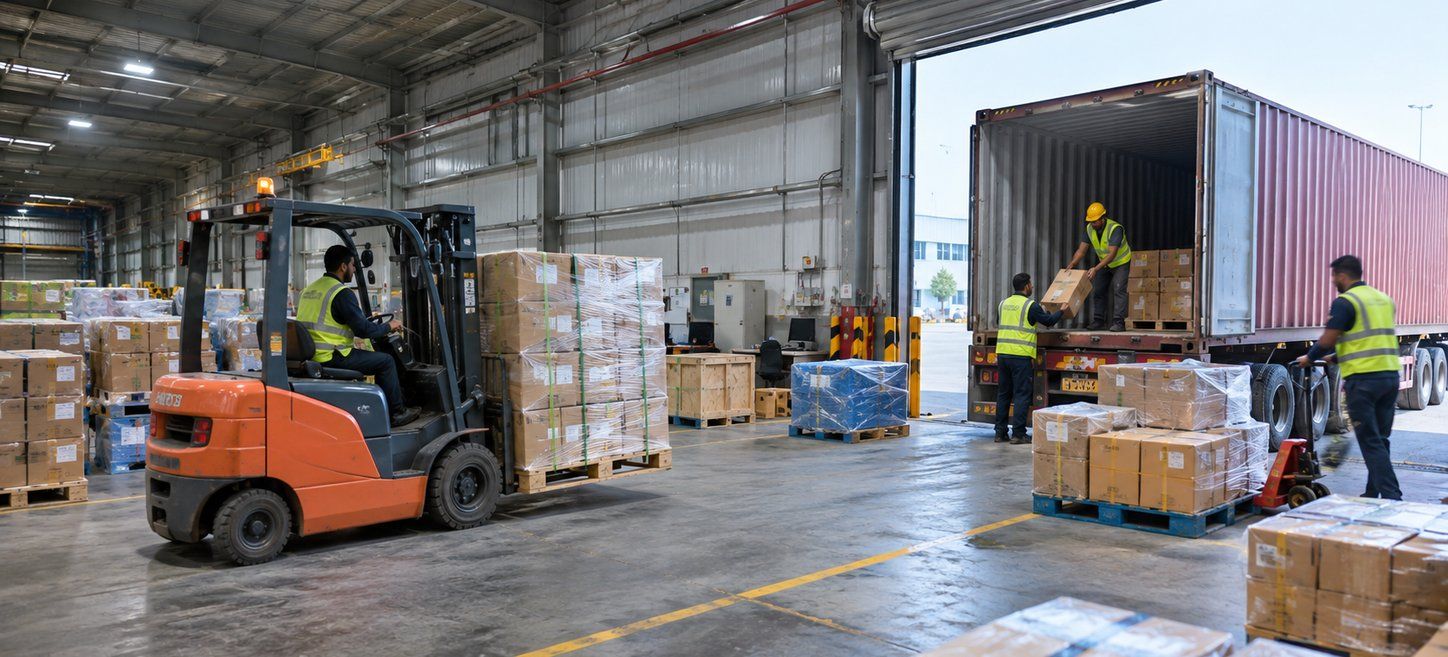
- Record the seal number and photograph the loaded container before the doors close. See container seals explained.
Container size codes explained
The four-character size and type code on the doors follows ISO 6346. The first character gives the length, the second the height and width, and the last two the type.
| Code | Meaning |
|---|---|
| 22G1 | 20ft, standard height, general purpose |
| 42G1 | 40ft, standard height, general purpose |
| 45G1 | 40ft, high cube, general purpose |
| 22R1 | 20ft reefer |
| 45R1 | 40ft high cube reefer |
| 22U1 | 20ft open top |
| 42P1 | 40ft flat rack |
Booking systems and terminal records often use these codes, so it helps to recognise them on a booking confirmation or equipment release order.
Ordering the right container: what to tell your forwarder
When you book, give your forwarder enough detail to release the right box first time:
- Container size and type, for example 40ft high cube.
- Total weight and volume of the cargo, and the heaviest single piece.
- Packing method: pallets, cartons, crates or loose items.
- Loading point and whether a forklift or loading bay is available.
- Any special needs, such as a food-grade or particularly clean container.
Getting this right avoids a second truck trip to swap an unsuitable container, which costs time and haulage charges.
Checking the container when it arrives for loading
Before loading starts, check that the container released to you is the size and type you booked, and that it is fit for your cargo. Look for holes or light coming through the walls and roof, a dry and clean floor, doors that open and lock properly, and no strong odours. Record the container number and photograph the empty interior. If the box is damaged or dirty, ask for a replacement before loading, not after.
Key takeaways
- A 20ft standard container holds about 33 m³, a 40ft about 67 m³ and a 40ft high cube about 76 m³.
- All three are 2.44 m wide; high cubes are about 30 cm taller than standard boxes.
- Practical loadable space is lower than internal volume because of pallets and packaging.
- Heavy cargo usually fills a 20ft by weight; light cargo suits a 40ft or high cube.
- Weight limits on the road and from the shipping line can be lower than the container rating.
- Check the plate on the container doors for its exact tare, payload and capacity.
Need help choosing a container?
Send us your cargo list with weights and carton sizes, and our team will suggest the right container or LCL option. See our sea freight service, LCL shipping, or request a quote.