Short answer: customs clearance in Dubai has no single price. You pay customs duty (usually 5% of the CIF value), 5% import VAT, Dubai Customs declaration and service fees, port and shipping line charges, your clearing agent’s fee, and sometimes inspection, storage or demurrage. For valuable goods, duty and VAT are usually the largest items. Fees and delays are what make one clearance cost much more than another.
What makes up the cost of a clearance
Most importers see clearance as one line on an invoice, but it is several separate charges collected by different parties.
| Charge | Who collects it | How it is calculated |
|---|---|---|
| Customs duty | Dubai Customs | Usually 5% of CIF value |
| Import VAT | Federal Tax Authority, via customs | 5% of CIF value plus duty |
| Declaration and service fees | Dubai Customs | Fixed fees per declaration and service |
| Delivery order and documentation | Shipping line or its agent | Per bill of lading |
| Terminal handling (THC) | Shipping line / terminal | Per container or per freight tonne |
| Clearing agent fee | Your customs broker or forwarder | Per declaration or per shipment |
| Inspection costs | Customs / terminal | Only if the cargo is selected for inspection |
| Storage, demurrage and detention | Terminal and shipping line | Per day after free time ends |
Customs duty: the 5% rule and its exceptions
Customs duty in the UAE is set by the GCC Common Customs Tariff, which applies a 5% rate to most goods. The duty is calculated on the CIF value, which is the cost of the goods plus insurance and freight to the UAE port.
Some goods are exempt, such as certain foods, medicines and goods covered by specific exemptions. A small group of goods, including tobacco and alcohol, carry much higher rates. Goods from countries with a trade agreement, such as the UAE–India CEPA, may enter at a reduced rate with a valid certificate of origin.
Read our full guide to UAE import duty, VAT and a worked example.
Import VAT
Import VAT is charged at 5% on the CIF value plus customs duty. Businesses registered for VAT in the UAE can usually report import VAT through their VAT return under the reverse-charge mechanism, instead of paying it in cash at clearance. Importers who are not registered pay it at the border.
The UAE Federal Tax Authority publishes the current VAT rules for imports.
Dubai Customs fees
Dubai Customs charges fixed fees for processing declarations and related services. These are small compared with duty on valuable goods but add up across many shipments. Current fees are listed by Dubai Customs.
Port and shipping line charges
Before the cargo can leave the port, the shipping line or its agent must issue a delivery order, which releases the container to you. The line charges for this and usually collects terminal handling charges (THC) at destination as well.
For LCL cargo, the container freight station (CFS) also charges for unpacking and handling, usually per cubic metre or freight tonne. Our guide to container shipping cost covers these line items in more detail.
Clearing agent fees
A clearing agent (customs broker) prepares and files the declaration, pays duty on your behalf, and arranges release. Fees depend on the number of declarations, how many HS codes are on the invoice, and whether permits or inspections are involved. A container with one product line is quicker to clear than one with fifty.
Inspection and storage: the costs you can avoid
Inspection costs arise when customs selects a container for physical examination. The terminal moves the box to an inspection area, and you pay for the moves and any labour. Inspections are more likely when documents are inconsistent or the goods are high-risk.
Storage, demurrage and detention start when free time ends. Port storage is charged by the terminal; demurrage and detention are charged by the shipping line for keeping its container. These costs rise daily and can quickly exceed every other clearance charge. See demurrage and detention in the UAE.
A worked example (illustrative)
This example is illustrative only. Figures are rounded and fees vary by shipment.
A Dubai importer brings in one 20′ container of furniture from India.
- Goods value: AED 80,000
- Freight and insurance: AED 4,000
- CIF value: AED 84,000
- Customs duty at 5%: AED 4,200
- VAT at 5% on AED 88,200 (CIF + duty): AED 4,410
On top of duty and VAT, the importer pays the Dubai Customs fees, the delivery order and THC, and the clearing agent’s fee. If the documents are complete and the container is cleared within free time, those charges are modest. If an invoice error causes a three-day hold and the container goes to inspection, storage and demurrage can add more than the agent’s fee and customs fees combined.
When each charge is paid: the clearance timeline
Charges fall due at different points, which is why cash planning matters for importers.
- Before arrival: the shipping line sends an arrival notice listing its destination charges. Paying these early means the delivery order can be issued as soon as the vessel berths.
- At declaration: customs duty, VAT (unless reverse-charged) and Dubai Customs fees are paid when the declaration is filed.
- At release: terminal charges, any inspection costs and port storage must be settled before the container leaves.
- After delivery: the shipping line charges detention if the empty container is returned late.
A clearance that is delayed at any of these steps pushes the next step back, and daily charges start to run.
FCL, LCL and air cargo: how charges differ
FCL (full container load) clearances are charged per container for terminal, delivery order and haulage costs. One declaration usually covers the whole box, so the cost per unit falls as the container fills.
LCL (less than container load) clearances add CFS handling charges, usually per cubic metre or freight tonne, because the consolidated container is unpacked at a container freight station. Small LCL shipments can carry a minimum charge that makes the cost per cubic metre higher.
Air cargo clearances at Dubai’s airports have their own handling and storage charges, calculated on weight. Storage at the airport starts sooner than at the seaport, so quick clearance matters even more for air freight.
Charges that surprise first-time importers
- Minimum charges on small LCL shipments, which can make a 1 CBM shipment cost almost as much to release as a 3 CBM one.
- Amendment fees when a declaration or bill of lading has to be corrected after filing.
- Permit fees for regulated goods, paid to the relevant authority rather than to customs.
- Container cleaning or damage charges if the empty container is returned dirty or damaged.
Who pays: how Incoterms decide it
The Incoterm in the sales contract decides who pays destination clearance.
- Under EXW, FCA, FOB, CFR, CIF, CPT and CIP, the buyer pays import clearance, duty and VAT.
- Under DAP, the seller delivers to the named place and the buyer clears and pays duty.
- Under DDP, the seller pays everything, including UAE duty and VAT.
See Incoterms 2020 explained for UAE importers.
How to keep clearance costs down
- Send documents before the vessel arrives so the declaration is ready on arrival.
- Use the correct HS code for each product. A wrong code means a wrong duty rate and possible penalties.
- Make invoice, packing list and bill of lading match, including weights and package counts.
- Arrange permits in advance for regulated goods such as food, cosmetics and electronics.
- Clear and collect within free time to avoid storage and demurrage.
- Check trade agreements that could reduce duty, and ask the supplier for the right certificate of origin.
- Consider a free zone if most of the goods will be re-exported.
Getting a clearance quote
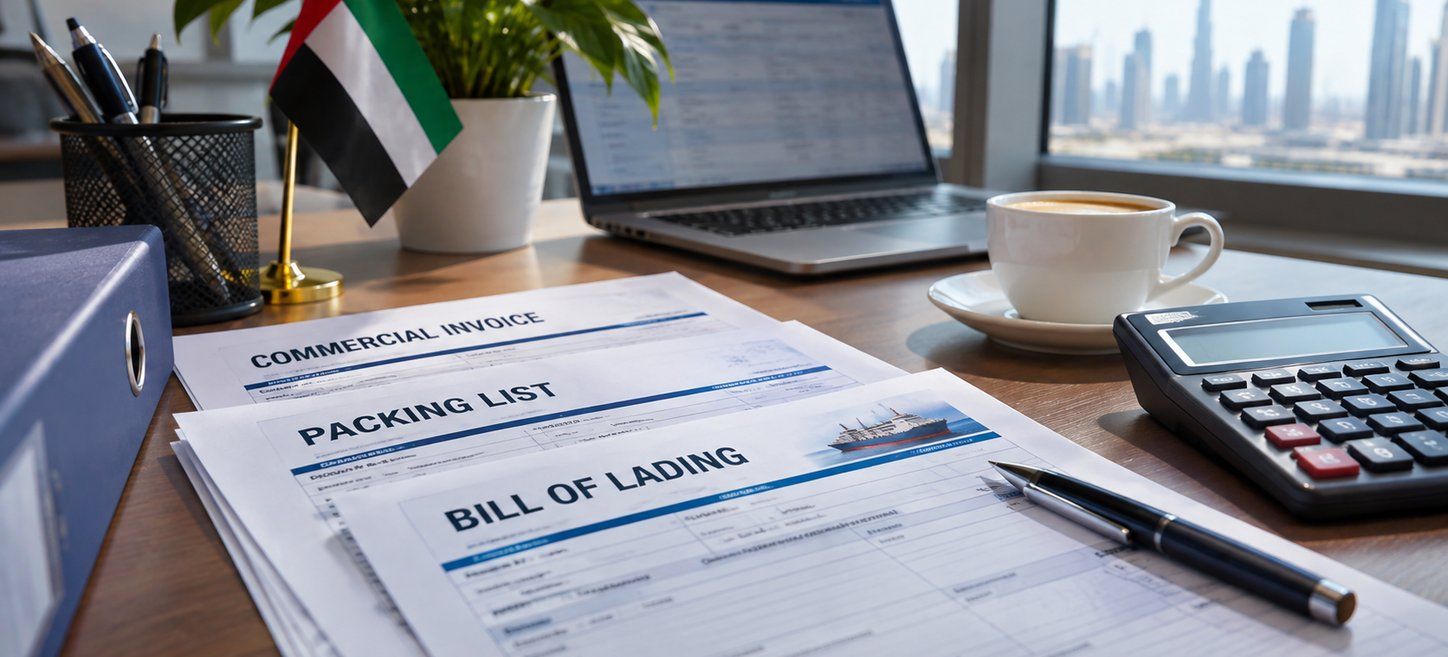
To quote a clearance accurately, a customs broker needs the commercial invoice, packing list, bill of lading or arrival notice, the HS codes, and any permits. With those, the agent can confirm the duty and VAT, list every fee, and point out problems before the cargo lands.
Our team handles customs clearance in Dubai together with port release and delivery. Send your documents with a quote request and we will list each charge before your cargo arrives.