Short answer: air freight from Dubai is priced on chargeable weight, which is the greater of the actual gross weight and the volumetric weight. For standard air cargo, volumetric weight = length × width × height (cm) ÷ 6,000. A light but bulky shipment is charged for the space it uses, so a 100 kg carton of pillows can be billed as 300 kg or more.
Why airlines charge on volume as well as weight
An aircraft runs out of space before it runs out of weight capacity when it carries light goods such as textiles, furniture or plastics. Volumetric weight (also called dimensional weight) converts the space a shipment occupies into an equivalent weight, so the airline is paid fairly for the space as well as the kilos.
The standard conversion used by airlines for general cargo assumes that 1 cubic metre equals 167 kg. This comes from the 6,000 divisor: 1,000,000 cm³ ÷ 6,000 = 166.67 kg.
How to calculate chargeable weight, step by step
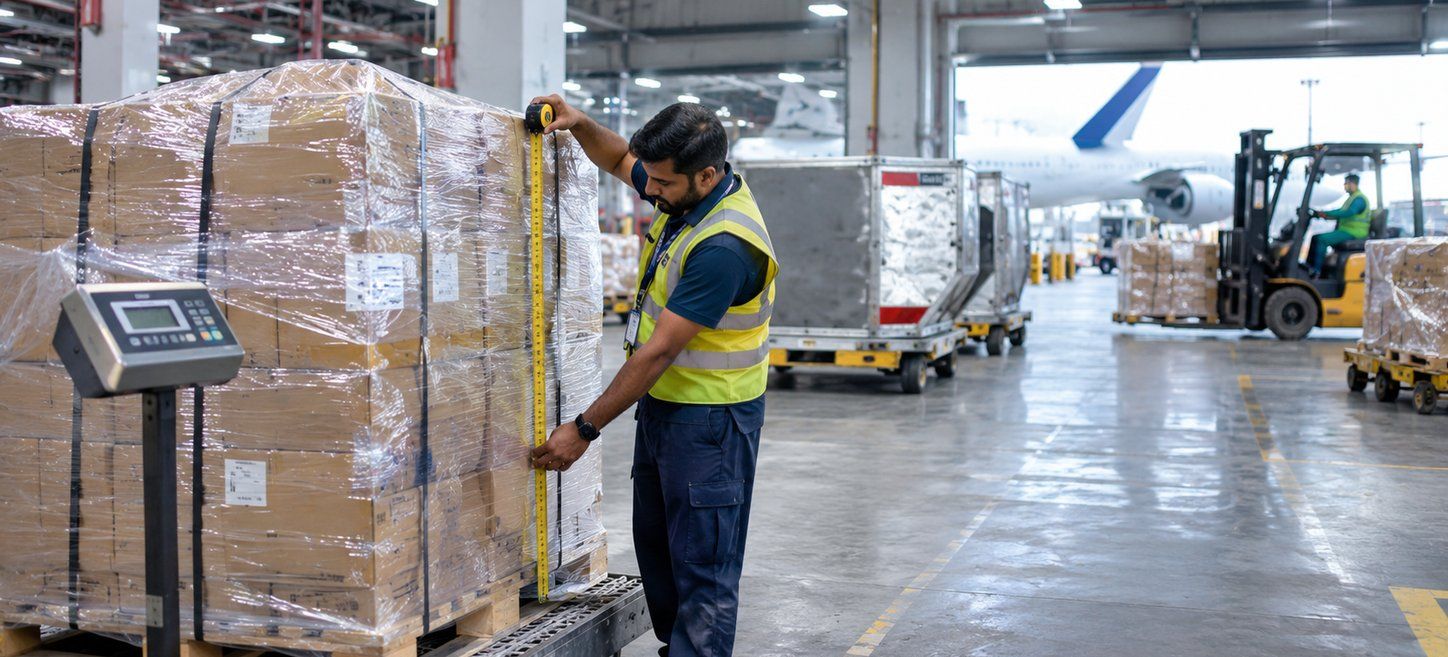
- Measure each piece in centimetres: length, width and height, at the longest points, including pallets and packaging.
- Multiply length × width × height to get the volume of each piece in cubic centimetres.
- Add the volumes of all pieces.
- Divide by 6,000 to get the volumetric weight in kilograms.
- Weigh the shipment to get the actual gross weight.
- Compare the two. The higher number is the chargeable weight.
Airlines round chargeable weight up, usually to the next half kilogram.
Worked examples (illustrative)
These examples are illustrative only.
Example 1: dense cargo, charged on actual weight
Ten cartons of machine spare parts, each 40 × 30 × 30 cm and 25 kg.
- Volume per carton: 36,000 cm³; total: 360,000 cm³
- Volumetric weight: 360,000 ÷ 6,000 = 60 kg
- Actual weight: 10 × 25 = 250 kg
- Chargeable weight: 250 kg (actual is higher)
Example 2: light cargo, charged on volume
Eight cartons of cushions, each 60 × 50 × 50 cm and 8 kg.
- Volume per carton: 150,000 cm³; total: 1,200,000 cm³
- Volumetric weight: 1,200,000 ÷ 6,000 = 200 kg
- Actual weight: 8 × 8 = 64 kg
- Chargeable weight: 200 kg (volumetric is higher)
The cushions weigh about a quarter of the spare parts but would be charged on almost as many kilos.
Example 3: one pallet
One pallet 120 × 100 × 150 cm, gross weight 180 kg.
- Volume: 1,800,000 cm³
- Volumetric weight: 1,800,000 ÷ 6,000 = 300 kg
- Chargeable weight: 300 kg
Lowering the same pallet to 110 cm tall would cut the volumetric weight to 220 kg, if the goods allow it.
Air freight vs courier vs sea: different divisors
| Mode | How volume is converted | 1 CBM equals |
|---|---|---|
| Air cargo (general) | cm³ ÷ 6,000 | 167 kg |
| Courier / express | cm³ ÷ 5,000 (common) | 200 kg |
| LCL sea freight | Weight or measure (W/M) | 1,000 kg |
| Road freight (part loads) | Varies by carrier, often per pallet or loading metre | Varies |
The table shows why light cargo is expensive by air and cheap by sea. One cubic metre of cushions is charged as at least 167 kg by air, but as 1 revenue ton (the same as 1,000 kg) by LCL sea freight. Sea freight per revenue ton is far cheaper than air freight per kilo, so for light, bulky goods the gap between the two modes is very large. See sea freight vs air freight from Dubai.
What makes up an air freight price
Chargeable weight is multiplied by the airline’s rate, but the total also includes several other charges:
- Air freight rate per chargeable kilo, often with rate breaks (lower rates at 45 kg, 100 kg, 300 kg, 500 kg and 1,000 kg).
- Fuel surcharge and security surcharge, usually per chargeable kilo.
- Airport handling and terminal charges at origin and destination.
- Air waybill fee and documentation.
- Export and import customs clearance.
- Pickup and delivery trucking.
Rate breaks: when shipping more costs less
Airlines publish lower per-kilo rates as weight increases. Sometimes it is cheaper to pay for the next break than to pay the higher rate on fewer kilos. For example, if the rate for 100 kg and above is lower than for 45 to 99 kg, a 90 kg shipment may cost less when charged as 100 kg. A good forwarder checks this automatically.
How to reduce your chargeable weight
- Use the smallest carton that protects the goods, and avoid shipping air.
- Avoid oversized pallets. A pallet that overhangs or has an uneven top is measured at its outer dimensions.
- Keep pallet heights low where the goods allow, because height adds volume fast.
- Consolidate small cartons into fewer, well-filled master cartons.
- Remove unnecessary packaging such as oversized inner boxes or loose filler.
- Split urgent and non-urgent goods: fly only what is needed now, and send the rest by sea.
- Ask for the rate break check on every quote.
Measurement mistakes that cost money
The cargo terminal measures and weighs every shipment on acceptance, and the airline bills on its figures, not yours. Common mistakes:
- Measuring the product, not the carton or pallet.
- Forgetting pallet height (usually 12 to 15 cm).
- Rounding dimensions down instead of up.
- Declaring net weight instead of gross weight.
If the terminal’s figures differ from the booking, the invoice changes too. Measure carefully at the warehouse and send the forwarder accurate dimensions for each piece.
Documents for air freight from Dubai
Air shipments need a commercial invoice, packing list with weights and dimensions per piece, and an air waybill issued by the airline or forwarder. Regulated goods may need permits, and anything containing lithium batteries, liquids or chemicals must be declared so it can be checked against dangerous goods rules before booking.
Packing cargo for air freight
Good packing lowers chargeable weight and protects goods during the many handling steps at airports.
- Use strong, double-wall cartons sized to the product.
- Palletise several cartons where possible, but keep pallets compact and level, without overhang.
- Mark each piece with the air waybill number, piece count and consignee.
- Use shock indicators or “fragile” marks for delicate goods, but do not rely on them in place of good packing.
Batteries, liquids and other dangerous goods by air
Air cargo has strict rules for dangerous goods. Lithium batteries, perfumes, aerosols, paints, some chemicals and many liquids are restricted and must be declared, packed and labelled correctly under IATA rules. Some cannot fly at all on passenger aircraft. Always tell your forwarder if a shipment contains batteries or liquids, even inside equipment. Undeclared dangerous goods can be refused at the terminal and can lead to penalties.
Key takeaways
- Air freight is charged on the greater of actual weight and volumetric weight.
- For general air cargo, volumetric weight is length × width × height in centimetres divided by 6,000, so 1 cubic metre counts as about 167 kg.
- Courier services often divide by 5,000, which makes light parcels more expensive.
- LCL sea freight treats 1 cubic metre as 1,000 kg, so light, bulky goods are far cheaper by sea.
- Smaller cartons, lower pallets and checking rate breaks are the simplest ways to cut the cost.
- Batteries, liquids and chemicals must be declared before booking because of dangerous goods rules.
When to choose air freight
Air freight is worth the premium when goods are urgent, valuable for their weight, perishable, or needed to avoid a production stop. It rarely makes sense for heavy or bulky goods with no deadline. Many importers fly a first batch to meet a launch date and send the remaining stock by sea.
Need a price? Our team arranges air freight from Dubai and will check the chargeable weight and rate breaks for you. Request a quote with the dimensions and weight of each piece.